The Pink Revolution: How Dragon Fruit is Turning Barren Land into Gold

For years, the dry, rocky slopes of the Inner Terai and the mid-hills were seen as fallow land—of little use for traditional paddy or maize. But in 2026, a vibrant pink fruit is changing that narrative. Dragon Fruit (Pitaya) has emerged as a symbol of the Modern Nepalese Dream, offering high-value income with minimal water requirements.
The Science of the Cactus
The transition to Dragon Fruit is a strategic move for the smart farmer. Unlike traditional crops, these cactus-derived plants are drought-tolerant and can thrive in poor soil if provided with proper drainage and support.
Economic Comparison: Traditional vs. Dragon Fruit
Traditional Cereal Model Annual Income: NPR 15,000 to 25,000 per ropani Water Needs: High (Rainfall dependent) Plant Lifespan: Single season (4-6 months) Harvest Frequency: Once or twice a year
Modern Dragon Fruit Model (2026) Annual Income: NPR 200,000 to 400,000 per ropani Water Needs: Very Low (Drip irrigation preferred) Plant Lifespan: Perennial (Productive for 20+ years) Harvest Frequency: Up to 10-12 times per season
While the initial setup cost—primarily for concrete pillars and high-quality cuttings—can reach nearly NPR 2.5 Lakhs per kattha, the benefit-to-cost ratio stands at a healthy 1.87. This means that for every rupee invested, the farmer is seeing nearly double the return within just a few years.
Case Study: The Dragon Queen of Tanahun
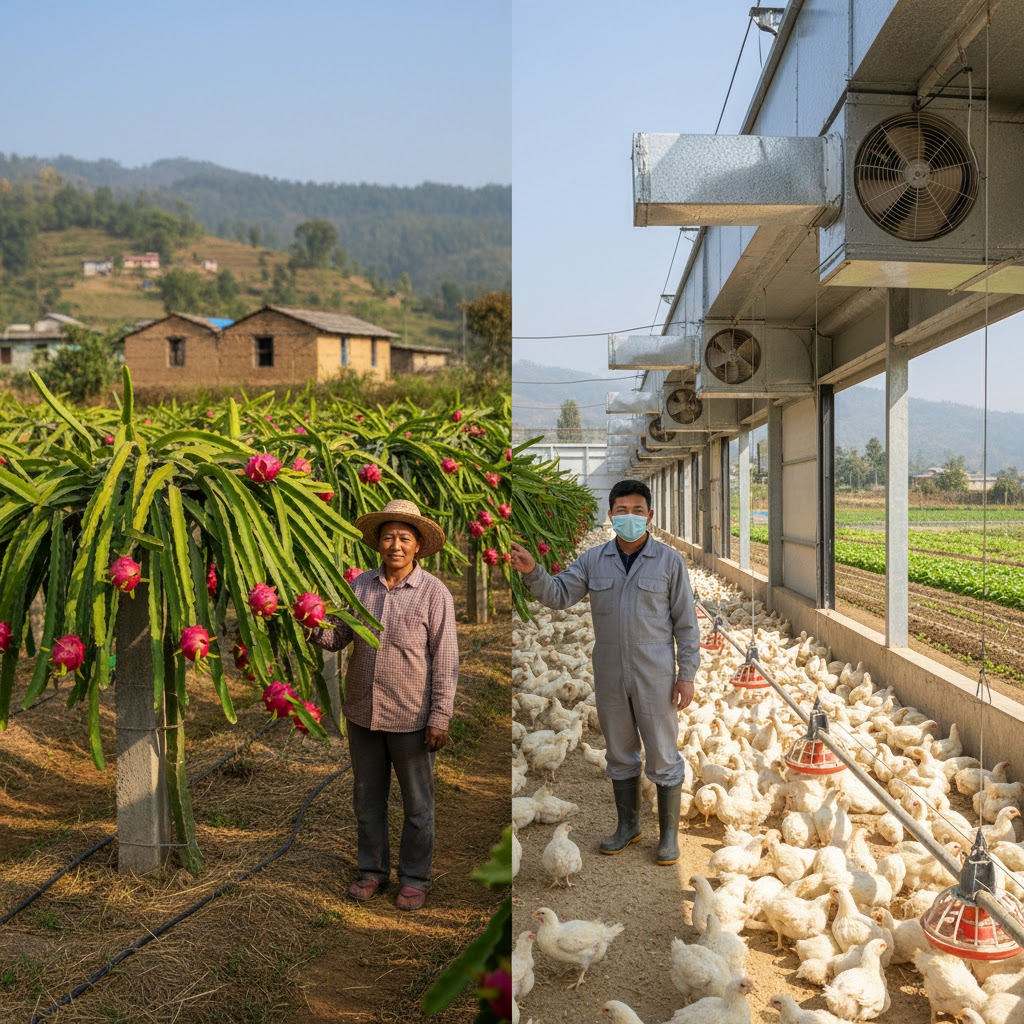
Kalpana Gauli’s story is a testament to the fact that agriculture has no gender or age limit. After 15 years in the boutique business, she turned to the soil, establishing Ma Ambe Alaukik Krishi Farm.
Last year, she earned NPR 1.6 million by selling dragon fruit from 2,100 plants on just nine ropanies of land. This year, with improved fruit quality and organic liquid fertilizers made from local herbs, her revenue is projected to exceed NPR 2 million. Her farm has also become an Observation Center, where students and government officials come to learn, proving that a successful farm is also a classroom for the community.
A Voice from the Earth
The rise of this exotic fruit reminds us of our own adaptability. As the renowned agricultural scientist M.S. Swaminathan famously said:
If agriculture goes wrong, nothing else will have a chance to go right.
For farmers like Kalpana, their service is providing health and organic nutrition to their community. They are ensuring that even our driest lands have a chance to go right.
The Modern Coop: Turning Poultry into Precision Business
If there is one sector that has truly industrialized in Nepal, it is poultry. From Chitwan to Biratnagar, the sound of the traditional backyard flock is being replaced by the hum of climate-controlled houses and automated feeding systems.
The Efficiency of the Automated Era
In the traditional poultry model, high mortality rates due to disease and temperature fluctuations often wiped out a farmer’s savings. The Modern Coop of 2026 solves this through precision technology.
Poultry Performance: Backyard vs. Climate-Controlled
Traditional Backyard Poultry Mortality Rate: 10% to 15% (High risk) Feed Conversion: 2.2 kg feed for 1 kg meat Ready for Market: 50 to 60 days
Modern Climate-Controlled House Mortality Rate: Below 3% to 5% (Managed risk) Feed Conversion: 1.6 kg feed for 1 kg meat Ready for Market: 38 to 42 days
By implementing computerized ventilation and nipple drinking systems, farmers are reducing water wastage and keeping birds healthy without heavy reliance on antibiotics. This is the technical efficiency that keeps Nepalese poultry competitive against imports.
Case Study: The Returnee’s Precision Farm
Bharat Kafle from Sindhuli spent years managing a grocery store in the chaos of Kathmandu. When he returned to his roots, he didn’t just start a farm; he started a smart farm.
Using a government subsidy for infrastructure, Bharat integrated his poultry waste with a high-value vegetable nursery. This Closed-Loop system is the pinnacle of modern efficiency—the waste from his 5,000 birds provides all the nutrients needed for his vegetables. Bharat now employs five family members and generates over NPR 1.3 million annually. He is no longer an employee in the city; he is an employer in his village.
A Voice from the Earth
As we automate our coops and scale our production, we must never lose sight of the responsibility we hold. As Mahatma Gandhi reminded us:
The greatness of a nation and its moral progress can be judged by the way its animals are treated.
Modern poultry farming at Agri Agenda isn’t just about units of meat—it’s about the ethical, hygienic, and humane treatment of the creatures that feed us.